
4ms Spectral Multiband Resonator for Generative Music and Sound Design
How Does the 4ms Spectral Multiband Resonator Work in Generative Modular Synthesis?
Introduction
The 4ms Spectral Multiband Resonator is one of the most unusual and inspiring modules available for modular synthesis. It exists as the original 4ms hardware module, as a software version in Softube Modular, and as the VCV Rack module called Rainbow.
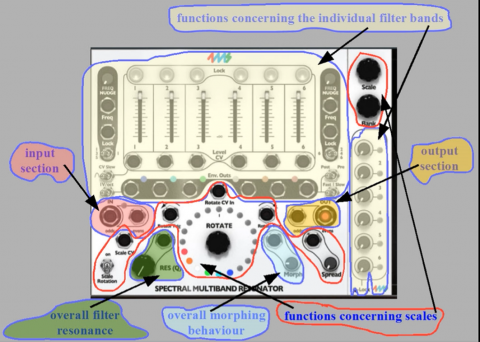
At its core, the module combines a noise source with six independently controllable resonant band-pass filters. These filters are tuned to musical scales and can be used to create evolving harmonic textures, atmospheric drones, generative backgrounds, melodic resonances, and complex sound-processing effects.
Unlike conventional oscillators, the Spectral Multiband Resonator generates musical material by filtering and emphasizing specific frequency regions. This makes it particularly useful in generative patches where gradual evolution and harmonic movement are more important than traditional melody generation.
Six Tuned Resonant Filters
The heart of the module consists of six resonant band-pass filters.
Each filter is tuned to a note belonging to a selected musical scale. Instead of manually tuning six separate oscillators, the module automatically places all six filters into musically meaningful relationships.
This approach allows users to generate:
Harmonic drones
Ambient textures
Evolving pads
Generative backgrounds
- Tonal noise sculptures
Because all filters belong to the same scale, even highly complex movements tend to remain musically coherent.
Scale Banks and Musical Organization
One of the most powerful features of the Spectral Multiband Resonator is its scale system.
Scales are organized into banks. Users first select a bank and then choose an individual scale within that bank.
This allows rapid movement between different harmonic worlds while maintaining the relationship between the six resonant bands.
For generative music, scale selection becomes a compositional tool. Changing scales can dramatically alter the emotional character of a patch without changing any other parameter.
Working Beyond a Single Octave
The six resonant bands are not limited to a single octave.
The module allows notes to be distributed across wider frequency ranges, creating richer and more spacious harmonic structures.
This makes it possible to create:
Wide spectral spreads
Layered harmonic clouds
Organ-like textures
Bell-like resonances
- Expansive ambient sound fields
The result often feels much larger and more orchestral than a traditional six-voice arrangement.
Fixing and Modulating Individual Bands
Another important feature is the ability to fix certain frequency bands while modulating others.
For example:
Two bands may remain stationary.
Two bands may slowly drift.
- Two bands may respond to external modulation.
This combination of stability and movement creates evolving harmonic structures that remain recognizable while continuously changing.
Using External Audio Sources
The Spectral Multiband Resonator is not limited to its internal noise source.
External audio can be fed into the module and processed through the six resonant filters.
This transforms ordinary sounds into:
Harmonic textures
Ethereal pads
Resonant drones
Spectral soundscapes
- Evolving ambient backgrounds
Speech, field recordings, percussion loops, and synthesizer sounds can all become raw material for generative processing.
Why This Module Matters for Generative Music
The Spectral Multiband Resonator occupies a unique position in modular synthesis because it combines:
Harmonic organization
Spectral filtering
Scale awareness
- Extensive modulation possibilities
Few modules can generate such complex and musically coherent results with relatively simple patching.
For ambient, generative, drone, and experimental music, it remains one of the most rewarding modules available.
Just click here to get more details about this topic, including graphs, presets, patches and videos.
Related articles
- Using the 4ms Spectral Multiband Resonator to Process External Audio
- 4ms Spectral Multiband Resonator Morph Function and Envelope Follower Explained
- Instruo Harmonàig Chord Qualities, Voicings and Inversions Explained
- Five Faces of Randomness in Generative Music
- Random Harmonic Progressions in Generative Music Using Sequential Switches
- Looping Envelopes in Generative Music: More Than Just ADSR Generators
- Mutable Instruments Marbles CV Domain Explained: Random Voltages, Quantization and Probability
- Instruo Harmonàig Explained: Generating Four-Voice Chords from a Single CV